
West Bengal is not just about paddy and jute. With the rise of modern retail, growing IT sector and a booming urban middle class, the demand for exotic vegetables (Colored Capsicum, English Cucumber, Cherry Tomatoes) and premium flowers (Dutch Roses, Gerbera) has skyrocketed. In this scenario, polyhouse farming in West Bengal brings the opportunity to fill the gap.
However, copy-pasting a polyhouse model from Maharashtra or Himachal Pradesh into Bengal will lead to disaster. The humidity, the monsoons, and the local bureaucracy require a completely customized approach.
This guide is your complete 2026 roadmap to setting up a profitable commercial polyhouse in West Bengal, securing your government subsidy, and navigating the local markets. Visit our Polyhouse Farming Guide for detailed guidance on polyhouse farming in India.
Polyhouse Subsidy in West Bengal (2026 Guidelines)
The financial backbone of any polyhouse project is the government subsidy. In West Bengal, you have two primary routes to secure funding.
1. State Horticulture Mission (SHM) / MIDH
The Department of Food Processing Industries and Horticulture (FPI&H), Government of West Bengal, implements the Mission for Integrated Development of Horticulture (MIDH).
- The Standard Subsidy: The government provides a 50% subsidy on the cost norm for setting up a Naturally Ventilated Polyhouse (NVPH) or a Fan & Pad greenhouse.
- Who Applies Here: Best for projects under 1 Acre (4,000 Sq. Mtr) targeting local vegetable or flower markets.
2. National Horticulture Board (NHB)
If you are planning a massive commercial project, NHB is the central authority.
- The Subsidy: 50% of the total project cost for open category, and up to 75% for SC/ST, women entrepreneurs, or projects in specific hilly terrains (like Darjeeling).
- The Catch: NHB loans strictly require a rigorous Detailed Project Report (DPR) and In-Principle Approval (IPA) before you lay a single brick.
FarmAtma Pro Tip: Do not rely solely on the “Matir Katha” portal for subsidy applications. While the portal is a great information hub, commercial polyhouse files move through the District Horticulture Officer (DHO). You must build a relationship with your local DHO from Day 1. Read our complete Polyhouse Subsidy Guide to understand the slippery process of getting polyhouse subsidy.
Localized Construction Costs: The West Bengal Reality
When calculating your ROI, you must account for West Bengal’s specific logistical realities.
While Howrah is a massive steel hub, the specific high-grade Galvanized Iron (GI) pipes (2mm thickness, 275 GSM) required for durable polyhouses are often transported from Pune, Raipur, or Delhi.
Estimated Cost Table (1 Acre / 4,000 Sq. Mtr NVPH in West Bengal):
| Component | Estimated Cost (2026 Market Rate) | Notes |
| GI Structure & Civil Work | ₹26,00,000 – ₹28,00,000 | Transport costs to North Bengal will increase this by 5-8%. |
| Cladding (Polyfilm & Nets) | ₹5,50,000 – ₹6,00,000 | 200-micron anti-drip film is mandatory for WB humidity. |
| Micro-Irrigation (Drip/Foggers) | ₹2,50,000 – ₹3,00,000 | Includes inline drip and overhead fogging systems. |
| Land Prep & Bed Formation | ₹1,50,000 | Deep ploughing and soil fumigation. |
| Total Infrastructure Cost | ~ ₹35.5 Lakhs to ₹38.5 Lakhs | Excludes crop input costs. |
The Application Process: Navigating Local Bureaucracy
Getting your bank loan and full amount of govt. subsidy in West Bengal is nothing less than a war. Perfect paperwork smoothen . Here is the chronological roadmap:
Step 1: The Land Documents (The Parcha Rule)
Banks and the NHB will immediately reject your file if your land title is not absolutely clear. In Bengal, your Record of Rights (RoR) is known as the Parcha or Porcha, and the account is the Khatian.
If the land is in your grandfather’s name, you must complete the mutation (Namjari) process and get a separate Parcha in your name before applying for the loan.
Step 2: The Detailed Project Report (DPR)
You cannot submit a generic Excel sheet. The bank requires a CMA-data-backed DPR showing your DSCR (Debt Service Coverage Ratio), projected yields, and localized market pricing.
Step 3: AIF Registration
Register your project on the central Agriculture Infrastructure Fund (AIF) portal to secure your 3% interest subvention. This brings your effective bank loan interest rate down to around 6%.
Step 4: DHO Submission & Joint Inspection
Submit the file to the District Horticulture Officer. A Joint Inspection Team (JIT) comprising bank officials and horticulture officers will visit your site to verify the land layout before granting clearance.
Here is the directory of the District Horticulture Offices (DHO) across the major districts of West Bengal.
Because individual officers are frequently transferred, it is always best to visit or address your correspondence to the “Deputy Director of Horticulture” or “District Horticulture Officer” at these official headquarters.
Note: Read our complete Polyhouse Bank Loan Guide to understand exactly what the bank manager is looking for.
Directory of District Horticulture Offices in West Bengal
| District | Office Location / Address |
| 1. Alipurduar | Office of the District Horticulture Officer, Dooars Kanya (District Collectorate), Alipurduar |
| 2. Bankura | Beside SDO Office, Collectorate Compound, Bankura – 722101 |
| 3. Birbhum | Prosasonik Bhavan, 3rd Floor, Room No. 413, Suri – 731101 |
| 4. Cooch Behar | ATC Complex, Vivekananda Street, Cooch Behar – 736101 |
| 5. Dakshin Dinajpur | Dakshin Dinajpur Collectorate Building, 2nd Floor, Balurghat – 733101 |
| 6. Darjeeling | DHO Office, Siliguri Mahakuma Parishad, Hakimpara, Siliguri – 734101 |
| 7. Hooghly | Rice Research Station Campus (R.S.), Chinsurah – 712102 |
| 8. Howrah | New Collectorate Building (5th Floor), 7 Rishi Bankim Chandra Road, Howrah – 711101 |
| 9. Jalpaiguri | Horticulture Research & Development Farm, Mohitnagar – 735102 |
| 10. Jhargram | Office of the District Horticulture Officer, Jhargram Collectorate, Jhargram |
| 11. Kalimpong | Nazareth Cottage, Below Banu Bhavan, 9 Mile, Kalimpong – 734301 |
| 12. Kolkata | Operates via State HQ (Benfish Tower, Salt Lake) & South 24 Parganas DHO |
| 13. Malda | District Horticulture Office, Malda Farm, English Bazar, Malda |
| 14. Murshidabad | Uddyan Bhawan, District Collectorate Premises, Cantonment Road, Berhampore – 742101 |
| 15. Nadia | State Horticulture Research & Development Station, Krishnagar – 741101 |
| 16. North 24 Parganas | Zilla Parishad Building (Ground Floor), Barasat – 700124 |
| 17. Paschim Bardhaman | Paschim Bardhaman Zilla Parishad Building, Court Compound, Asansol – 713304 |
| 18. Paschim Medinipur | Paschim Medinipur Zilla Parishad Bldgs., Medinipur Town – 721101 |
| 19. Purba Bardhaman | Bardhaman Zilla Parishad, Court Compound, Burdwan – 713101 |
| 20. Purba Medinipur | DHO Office, Abash Bari, Tamluk – 721636 |
| 21. Purulia | Purulia Zilla Parishad Building, Purulia – 723101 |
| 22. South 24 Parganas | New Administrative Bldgs (8th Floor), 12 Biplabi Kanai Bhattacharya Sarani, Alipore, Kolkata – 700027 |
| 23. Uttar Dinajpur | Karnajora, Raiganj, Qtr. No. M-72 – 733101 |
FarmAtma Strategy for Dealing with the DHO:
When you are applying for the MIDH polyhouse subsidy in West Bengal, do not just drop the file at the reception.
- Find the SDHO first: Many districts have a Sub-Divisional Horticulture Officer (SDHO). It is often faster to get your initial site verification done by the SDHO before the file moves to the district headquarters.
- Take the DPR: Never visit the DHO empty-handed. Always carry a preliminary Detailed Project Report (DPR) and your Parcha (Land Record) on the first visit so they know you are a serious commercial investor, not just inquiring casually.
Best Crops for West Bengal’s Agro-Climatic Zones
West Bengal is geographically unique, officially divided into distinct agro-climatic zones. You cannot copy the polyhouse setup of Jalpaiguri and expect it to work in Purba Medinipur. To maximize ROI, your crop choice and structural design must match your specific zone.
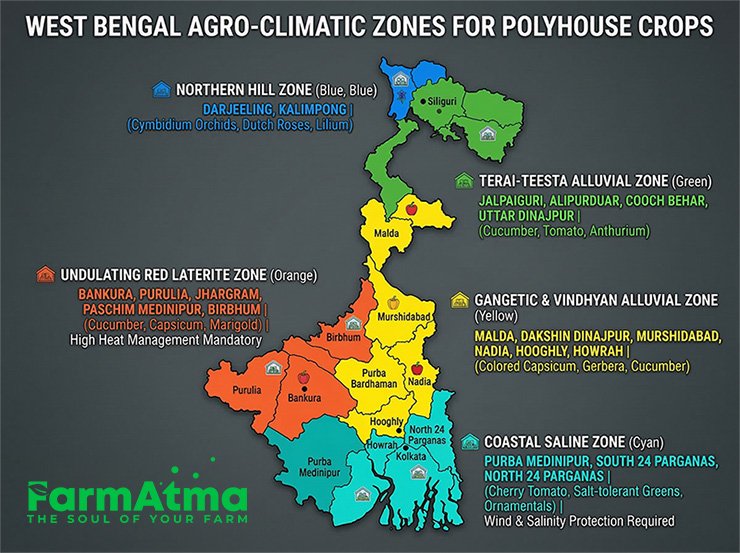
Here is the strategic breakdown covering all 23 districts of the state:
1. Northern Hill Zone
- Districts Covered: Darjeeling, Kalimpong.
- The Climate Challenge: A Subtropical Highland climate with intense monsoon downpours, high-altitude chill, and strong winds.
- Polyhouse Strategy: While the cooler temperatures are excellent for temperate exotics, the heavy, continuous monsoon rain is your biggest threat. You must use a reinforced tubular steel structure with a deeper concrete foundation to withstand hill winds, and high-quality 200-micron UV-stabilized polyfilm to prevent water ingress. Construction cost of polyhouse are generally up to 15% higher than plains.
- Top Profitable Crops: Cymbidium Orchids, Dutch Roses, Lilium, and Anthurium. This region has immense export potential for premium flowers to neighboring states and international markets.
2. Terai-Teesta Alluvial Zone (The Foothills)
- Districts Covered: Jalpaiguri, Alipurduar, Cooch Behar, Uttar Dinajpur.
- The Climate Challenge: Exceptionally high rainfall and a naturally high groundwater table leading to waterlogging.
- Polyhouse Strategy: Excellent internal drainage is your highest priority. You cannot grow on flat ground here; raised beds (at least 1.5 to 2 feet high) are mandatory to prevent root rot.
- Top Profitable Crops: Off-season English Cucumber, High-value Tomatoes, and Anthurium.
3. Undulating Red Laterite Zone (The Western Tract)
- Districts Covered: Purulia, Bankura, Jhargram, Paschim Medinipur, Paschim Bardhaman, Birbhum.
- The Climate Challenge: Extreme heat (often hitting 45°C in May) and dry, porous laterite soil with low water-holding capacity.
- Polyhouse Strategy: Setting up a commercial project here—much like managing our own 2-acre trial farm in Bankura—means heat management is everything. A standard polyhouse will turn into an oven in the summer. You must invest in superior top-ventilation, retractable thermal shade nets (Aluminet), and high-pressure overhead foggers to artificially drop the internal temperature.
- Top Profitable Crops: English Cucumber (due to its short 90-day cycle, avoiding peak heat), Bell Peppers, and robust flowers like Marigold for regional festive demand.
4. Gangetic & Vindhyan Alluvial Zone (The Central Plains)
- Districts Covered: Malda, Dakshin Dinajpur, Murshidabad, Nadia, Hooghly, Howrah, Purba Bardhaman, Kolkata (Urban).
- The Climate Challenge: The “Golden Bowl” of Bengal boasts highly fertile soil, but suffers from suffocating humidity during the monsoon and post-monsoon months.
- Polyhouse Strategy: Fungal diseases (especially Powdery Mildew and Downy Mildew) are your biggest threats in this zone. Strict biosecurity at the entrance and excellent side-ventilation are non-negotiable to keep the air moving.
- Top Profitable Crops: Colored Capsicum (Red & Yellow), Gerbera, and Seedless Cucumber. These have massive daily B2B demand in Kolkata’s hotel and QSR (Quick Service Restaurant) industry.
5. Coastal Saline Zone (The Southern Delta)
- Districts Covered: Purba Medinipur, South 24 Parganas, North 24 Parganas.
- The Climate Challenge: High soil/water salinity and the constant threat of severe cyclonic storms (like Amphan and Yaas) from the Bay of Bengal.
- Polyhouse Strategy: Standard designs will collapse here. You need “aerodynamic” or gothic-arch structures designed specifically for high wind-load resistance. Furthermore, the local groundwater is often too salty for sensitive exotic roots, meaning you may need a small RO plant or rainwater harvesting pond to feed your drip irrigation system.
- Top Profitable Crops: Cherry Tomatoes, specialized salt-tolerant exotic greens, and potted ornamental plants.
Target Markets: Where to Sell Your Harvest in WB
A polyhouse is a factory. Do not build the factory until you know where the product is going.
- Koley Market (Sealdah, Kolkata): The nerve center of Bengal’s vegetable trade. Best for bulk liquidation, though prices fluctuate daily.
- Mechua Fruit Market (Kolkata): The primary hub for exotic fruits and premium imports/exports.
- Mullick Ghat Flower Market: One of the largest flower markets in Asia. If you are growing Gerbera or Roses, this is your wholesale clearing house.
- Direct B2B (The Real Money): Bypass the mandis. Tie up directly with Spencer’s Retail, BigBasket supply chains, or the procurement managers of 5-star hotel chains in Kolkata (Taj, ITC, JW Marriott). They require consistent, high-quality, graded produce—exactly what a polyhouse delivers.
Why Bengal Farmers Fail (And How to Succeed)
The #1 reason commercial polyhouse projects fail in West Bengal is Financial Mismanagement prior to construction.
Farmers often rely on free, copy-pasted project reports provided by the polyhouse construction vendors. These vendors inflate the profitability to sell their steel structures. When the real costs hit—or the bank manager grills the farmer on their DSCR ratio—the project collapses.
You are building a multi-lakh agribusiness. You cannot afford to guess your financial model.
Expert Insight: As outlined in my book How to Become a Crorepati Farmer in India, treating agriculture as a manufacturing business is the only way to scale. In West Bengal, the sheer population density and the massive consumption engine of Kolkata, Siliguri and Durgapur make it one of the most lucrative, yet untapped, markets for high-value protected cultivation.
Ready to Start Your Project?
Securing the West Bengal horticulture subsidy and a bank loan requires a flawless, bank-ready Detailed Project Report (DPR). If your financial ratios are off by even a fraction, the DHO and the Bank Manager will reject your file.
Don’t leave your ₹40 Lakh project to chance.
Get the exact blueprints, pre-filled DPR templates tailored for the Bengal market, and our ruthless vendor-negotiation scripts inside the Commercial Polyhouse Masterplan.