
Maharashtra is the undisputed heartbeat of protected cultivation in India. If you are planning to build a commercial polyhouse here in 2026, you are in the best state to do it thanks to massive manufacturing hubs in Pune and the Vashi APMC market. But before we dive into the specific MahaDBT subsidies and local Pune freight advantages, make sure you understand the core business model. If you are starting from zero, read our Master Guide to Polyhouse Farming in India first to understand the fundamental difference between naturally ventilated and climate-controlled structures.
Polyhouse Subsidy in Maharashtra: MahaDBT & NHB (2026 Guidelines)
Maharashtra has digitized its agricultural as well as polyhouse subsidy process better than almost any other state. You do not need to chase files across different departments; everything goes through a single window.
1. The MahaDBT Portal (State Scheme / MIDH)
The Maharashtra government implements the National Horticulture Mission (NHM/MIDH) through its centralized MahaDBT Farmer Portal (Aaple Sarkar MahaDBT).
- The Subsidy: A standard 50% subsidy on the government cost norm for setting up a Naturally Ventilated Polyhouse (NVPH) or Shade Net House.
- The Lottery System: Because demand in Maharashtra is massive, applications on MahaDBT are often selected via a computerized lottery system. If selected, your file moves to the Taluka Agriculture Officer (TAO).
2. National Horticulture Board (NHB)
For large-scale commercial projects (typically over 1 Acre) targeting export markets or high-tech automation.
- The Subsidy: 50% of the total project cost.
- The Catch: NHB projects require a highly detailed, bank-approved Detailed Project Report (DPR) and an In-Principle Approval (IPA) before construction begins. Do not start ground-leveling until you have this letter.
Note: Read our complete Polyhouse Subsidy Guide to understand what the lengthy process of getting subsidy for your polyhouse project.
Localized Construction Costs: The “Pune Advantage”
This is where Maharashtra farmers have a massive advantage over the rest of the country.
Because Pune, Nashik, and neighboring Gujarat are manufacturing hubs for high-grade Galvanized Iron (GI) pipes, UV-stabilized polyfilms, and drip irrigation systems (like Jain Irrigation), your freight and transport costs are significantly lower.
Estimated Cost Table (1 Acre / 4,000 Sq. Mtr NVPH in Maharashtra):
| Component | Estimated Cost (2026 Market Rate) | The Maharashtra Advantage |
| GI Structure & Civil Work | ₹24,00,000 – ₹26,50,000 | Save ~₹1.5L on freight compared to Eastern India. |
| Cladding (Polyfilm & Nets) | ₹5,00,000 – ₹5,50,000 | Easy access to local manufacturers (Ginegar, Essen). |
| Micro-Irrigation & Foggers | ₹2,50,000 | High availability of skilled local technicians. |
| Land Prep & Bed Formation | ₹1,50,000 | Hard Murum soil may require extra tilling costs. |
| Total Infrastructure Cost | ~ ₹33.0 Lakhs to ₹36.0 Lakhs | Excludes crop input costs. |
Best Crops for Maharashtra’s Agro-Climatic Zones
Maharashtra is geographically massive. A polyhouse structure designed for the mild, breezy hills of Satara will completely fail in the blistering 45°C summer heat of Nagpur. To maximize your ROI and secure your bank loan, your crop choice and structural design must match your specific zone.
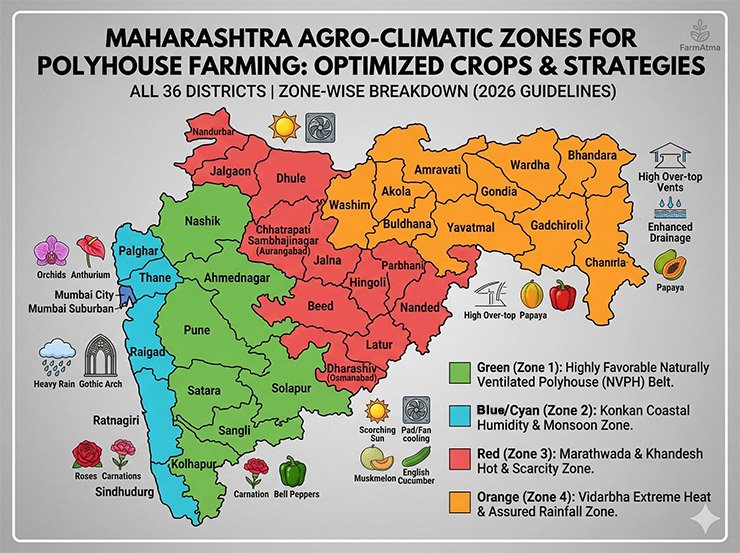
Here is the strategic polyhouse breakdown covering all 36 districts of the state:
1. Western Maharashtra & Sub-Montane Zone (The “Polyhouse Capital”)
- Districts Covered: Pune, Satara, Sangli, Kolhapur, Solapur, Ahmednagar, Nashik.
- The Climate Challenge: This is the “Goldilocks Zone.” It features mild winters, moderate summers, and excellent diurnal temperature variation (warm days, cool nights).
- Polyhouse Strategy: A standard Naturally Ventilated Polyhouse (NVPH) with 200-micron UV film and 50% shade nets works brilliantly here. Because the climate is naturally favorable, your capital expenditure on extreme cooling equipment is much lower.
- Top Profitable Crops: Dutch Roses, Gerbera, Carnations, Colored Capsicum, and Cherry Tomatoes. The proximity to the Mumbai/Pune airports and APEDA packhouses makes this the ultimate export hub.
2. The Konkan Coastal Zone
- Districts Covered: Mumbai City, Mumbai Suburban, Thane, Palghar, Raigad, Ratnagiri, Sindhudurg.
- The Climate Challenge: Extreme humidity, heavy and relentless coastal monsoons, salt spray from the Arabian Sea, and the severe risk of cyclonic winds.
- Polyhouse Strategy: Fungal diseases (like Downy Mildew and Botrytis) thrive in this humidity. You need “aerodynamic” structures with steep gothic arches to shed heavy rain and withstand high wind loads. Excellent side-ventilation is non-negotiable to keep the air moving, and anti-drip polyfilms are mandatory.
- Top Profitable Crops: Orchids, Anthurium, high-value exotic pot plants, and off-season leafy greens (lettuce, basil) targeted directly at the massive B2C/Hotel market in Mumbai.
3. Marathwada & Khandesh (The Scarcity & Dry Zone)
- Districts Covered: Chhatrapati Sambhajinagar (formerly Aurangabad), Jalna, Beed, Dharashiv (formerly Osmanabad), Nanded, Latur, Parbhani, Hingoli, Dhule, Nandurbar, Jalgaon.
- The Climate Challenge: Arid conditions, extreme dry heat in the summer months, and severe groundwater scarcity.
- Polyhouse Strategy: Heat and water management are your absolute priorities. Standard NVPH structures will turn into furnaces in May. If you have the budget, Fan & Pad (climate-controlled) systems are ideal here. If you are building an NVPH, you must use retractable Aluminet thermal screens, high-pressure overhead foggers, and invest heavily in a large rainwater harvesting pond.
- Top Profitable Crops: English Cucumber (short 90-day cycles allow you to harvest and clear the greenhouse before the peak summer heat hits), Muskmelon, and robust, heat-tolerant Tomato varieties.
4. Vidarbha (The Extreme Heat & Assured Rainfall Zone)
- Districts Covered (11): Nagpur, Amravati, Akola, Washim, Buldhana, Yavatmal, Wardha, Chandrapur, Bhandara, Gondia, Gadchiroli.
- The Climate Challenge: Blistering summer heat (often hitting 46°C – 47°C) combined with a moderate to heavy monsoon season.
- Polyhouse Strategy: You face the double threat of extreme heat followed by heavy rain. Like Marathwada, you need maximum top-ventilation and foggers to artificially drop the internal temperature. However, unlike the dry zones, your foundation and internal drainage systems must be deeply reinforced to handle the monsoon runoff without waterlogging your root zones.
- Top Profitable Crops: English Cucumber, Bell Peppers, and high-value Seedless Papaya (often grown under specialized Shade Net structures here rather than full polyfilm to allow better airflow while preventing viral vectors).
The Application Process: Mastering the Paperwork
The Maharashtra agricultural bureaucracy is efficient but strict. If your paperwork is incomplete, your MahaDBT application will be instantly rejected.
Step 1: The Land Documents (The 7/12 Extract)
You cannot apply for any loan or subsidy without a clear 7/12 Extract (Saat Bara Utara) and the 8A (Aath A) land holding certificate.
Crucial Rule: The land must be agriculturally zoned, and if there are multiple co-owners on the 7/12, you will need a registered No Objection Certificate (NOC) from all of them.
Step 2: Apply on MahaDBT Portal
Create a profile on the MahaDBT Farmer portal. Upload your Aadhaar, 7/12, 8A, and a preliminary quotation from a registered greenhouse vendor.
Step 3: The TAO & SDAO Inspection
Once selected in the lottery, the Taluka Agriculture Officer (TAO) will conduct a pre-construction site visit with GPS-tagged photos. The file then moves to the Sub-Divisional Agriculture Officer (SDAO).
Step 4: The Bank DPR & AIF
Simultaneously, approach your bank with a rock-solid Detailed Project Report (DPR). Ensure you register your project under the central Agriculture Infrastructure Fund (AIF) to secure a 3% interest subvention on your loan.
Note: Read our complete Polyhouse Bank Loan Guide to understand exactly what the bank manager is looking for.
Target Markets: Where to Sell in Maharashtra
Growing the crop is only 20% of the business; selling it is the other 80%.
- Vashi APMC (Navi Mumbai): The largest wholesale market in India. If you are growing high volumes of Colored Capsicum or Cucumber, this is your primary liquidation hub.
- Gultekdi Market (Pune): A massive hub for both vegetables and floriculture, feeding the entire IT and hospitality sector of Pune.
- Dadar & Kalyan Flower Markets: The traditional nerve centers for loose and cut flowers in the MMR region.
- Export Packhouses (APEDA): If you are in the Nashik/Pune belt, bypass local markets entirely. Register with APEDA, tie up with export packhouses, and send your Dutch Roses or exotic veggies directly to the UAE or Europe.
Directory of DSAO Offices in Maharashtra (2026)
While you apply online, building a relationship with your local officers is vital. In Maharashtra, polyhouse subsidies are primarily monitored by the District Superintending Agriculture Officer (DSAO) under the Department of Agriculture.
1. Pune Division (The Polyhouse Hub)
| District | Office Location / Address |
| Pune | DSAO Office, Sinchan Bhavan, Shivajinagar, Pune – 411005 |
| Satara | DSAO Office, Krishinagar, Satara – 415003 |
| Sangli | DSAO Office, Administrative Building, Vishrambag, Sangli – 416415 |
| Kolhapur | DSAO Office, Central Building, Tarabai Park, Kolhapur – 416003 |
| Solapur | DSAO Office, Near Rangbhavan, Solapur – 413003 |
2. Nashik Division
| District | Office Location / Address |
| Nashik | DSAO Office, Shingada Talav, Near Gadkari Chowk, Nashik – 422002 |
| Ahmednagar | DSAO Office, Station Road, Ahmednagar – 414001 |
| Jalgaon | DSAO Office, State Farming Corporation Campus, Jalgaon – 425001 |
| Dhule | DSAO Office, Old Collectorate Premises, Dhule – 424001 |
| Nandurbar | DSAO Office, Administrative Building, Nandurbar – 425412 |
3. Chhatrapati Sambhajinagar Division (Marathwada)
| District | Office Location / Address |
| Chhatrapati Sambhajinagar | DSAO Office, Krishi Bhavan, Peer Bazar, Osmanpura – 431005 |
| Jalna | DSAO Office, Krishi Sankul, Jalna – 431203 |
| Beed | DSAO Office, Nagar Road, Beed – 431122 |
| Latur | DSAO Office, MIDC Area, Latur – 413531 |
| Dharashiv (Osmanabad) | DSAO Office, Near Collectorate, Dharashiv – 413501 |
| Nanded | DSAO Office, Vasant Nagar, Nanded – 431602 |
| Parbhani | DSAO Office, Krishi Bhavan, Parbhani – 431401 |
| Hingoli | DSAO Office, Near District Court, Hingoli – 431513 |
4. Konkan Division
| District | Office Location / Address |
| Mumbai City | Covered under Konkan Bhavan & Thane / Suburban jurisdictions. |
| Mumbai Suburban | DSAO Office, Konkan Bhavan, Navi Mumbai – 400614 |
| Thane | DSAO Office, Near Collector Office, Thane (W) – 400601 |
| Palghar | DSAO Office, Administrative Building, Palghar – 401404 |
| Raigad | DSAO Office, Rautwadi-Veshvi, Tal. Alibag, Raigad – 402209 |
| Ratnagiri | DSAO Office, District Administrative Building, Ratnagiri – 415612 |
| Sindhudurg | DSAO Office, Sindhudurg Nagari, Oros – 416812 |
5. Amravati Division (Western Vidarbha)
| District | Office Location / Address |
| Amravati | DSAO Office, Camp Road, Amravati – 444602 |
| Akola | DSAO Office, Krishi Nagar, Akola – 444001 |
| Washim | DSAO Office, Civil Lines, Washim – 444505 |
| Buldhana | DSAO Office, Chikhli Road, Buldhana – 443001 |
| Yavatmal | DSAO Office, Civil Lines, Yavatmal – 445001 |
6. Nagpur Division (Eastern Vidarbha)
| District | Office Location / Address |
| Nagpur | DSAO Office, Administrative Building, Civil Lines, Nagpur – 440001 |
| Wardha | DSAO Office, Sevagram Road, Wardha – 442001 |
| Bhandara | DSAO Office, Beside Bank of Baroda, Rajiv Gandhi Chowk, Bhandara – 441904 |
| Gondia | DSAO Office, Krishi Sankul, Gondia – 441614 |
| Chandrapur | DSAO Office, Mul Road, Chandrapur – 442401 |
| Gadchiroli | DSAO Office, Complex Area, Gadchiroli – 442605 |
The Official Chain of Command (Bottom to Top)
If you want to know exactly how your file moves, you can use this hierarchy:
- Agriculture Assistant (Krishi Sahayak) – Village level.
- Circle Agriculture Officer (CAO) – A cluster of villages.
- Taluka Agriculture Officer (TAO) – The Block/Tehsil level (First major approval).
- Sub-Divisional Agriculture Officer (SDAO) – Manages a few Talukas.
- District Superintending Agriculture Officer (DSAO) – The District Head (Final financial sign-off).
FarmAtma Pro-Tip for your readers: Always make friends with the TAO first. If the TAO is not satisfied with your site prep or structural materials, your file will never even reach the DSAO’s desk for payment.
Why Do Polyhouse Projects Fail in Maharashtra?
Despite the amazing infrastructure, projects fail here because of Aggressive Vendor Selling. Unscrupulous contractors will sell you a generic polyhouse structure in Vidarbha without installing the necessary cooling systems, or they will provide a fake, inflated Project Report just to get your bank loan passed.
When the summer hits, the crop dies, the bank EMI starts, and the business collapses.
Expert Insight: Here is the brutal truth about the polyhouse industry in Maharashtra: The person selling you the steel is not the person paying your bank loan. Because manufacturing hubs like Pune and Nashik have dozens of competing contractors, vendors are highly incentivized to sell you the most expensive, heavy-duty structure possible—even if your specific district’s climate doesn’t actually require it. If you rely entirely on a contractor’s “free” project report to plan your ₹40 Lakh business, you are handing over control of your ROI to a salesman, not an agronomist. To survive in this industry, you must become the CEO of your farm. That means knowing how to audit a Bill of Materials and cross-check climate data before you sign the cheque.
The Blueprint for Success
Securing the MahaDBT subsidy and a bank loan requires a flawless, localized Detailed Project Report (DPR). If your Debt Service Coverage Ratio (DSCR) is off by even a fraction, the bank will reject your file.
Don’t risk your ₹40 Lakh investment on a free, copy-pasted Excel sheet from a steel vendor.
Get the exact blueprints, pre-filled DPR templates tailored for Maharashtra’s specific cost norms, and our ruthless vendor-negotiation checklists inside the Commercial Polyhouse Masterplan.