
Uttar Pradesh is an ideal location for polyhouse cultivation of high-value crops. If you are planning to build a commercial polyhouse in Uttar Pradesh in 2026, your geographical positioning is your greatest asset. With rapid expressway development and direct access to the Azadpur Mandi, marketing your high-value exotic vegetables is very easy.
But before we dive into the specific UP Horticulture subsidies, local construction costs, and the Khatauni paperwork, make sure you understand the core business model. If you are starting from zero, read our Master Guide to Polyhouse Farming in India first to understand the fundamentals of polyhouse farming.
Polyhouse Subsidy in UP: UP Horticulture & MIDH (2026)
Uttar Pradesh manages its protected cultivation subsidies heavily through the Mission for Integrated Development of Horticulture (MIDH) and the State Horticulture Mission.
1. The Subsidy Structure
- The Subsidy: A flat 50% subsidy on the government’s normative cost for setting up a Polyhouse, Shade Net, or walk-in tunnels.
- Component Subsidies: UP also offers separate, highly lucrative 50% subsidies for planting material (especially for high-value crops like Gerbera and Carnations) and micro-irrigation under the Per Drop More Crop (PDMC) scheme.
2. The Online Portal (DBT)
The application process is now digitized via the UP Agriculture Department’s DBT (Direct Benefit Transfer) portal. Approvals are generally handled on a “first-come, first-served” basis against district-level targets.
Polyhouse Construction Cost in UP: The “NCR Freight Factor”
While UP doesn’t have the exact manufacturing density of Pune, Western UP benefits massively from proximity to Delhi and Haryana industrial hubs. Sourcing GI pipes and polyfilms from the NCR region keeps freight costs manageable for Western and Central UP, though costs rise as you move toward Purvanchal (Eastern UP).
Estimated Cost Table (1 Acre / 4,000 Sq. Mtr in UP):
| Component | Estimated Cost (2026 Market Rate) | The UP Strategy |
| GI Structure & Civil Work | ₹25,00,000 – ₹28,00,000 | Must withstand heavy winter storms and strong summer winds. |
| Climate Control (Crucial in UP) | ₹6,00,000 – ₹8,50,000 | Fan & Pad systems or high-end foggers are mandatory for summer. Thermal screens are required for winter frost. |
| Cladding (Polyfilm & Nets) | ₹5,00,000 – ₹5,50,000 | 200-micron anti-drip/anti-fog film is essential for UP winters. |
| Micro-Irrigation | ₹2,50,000 | Inline drip systems with venturi injectors. |
| Total Infrastructure Cost | ~ ₹38.5 Lakhs to ₹44.5 Lakhs | Climate control pushes the base cost higher than other states. |
Note: For a detailed breakdown of polyhouse construction cost per acre, read our Detailed Polyhouse Construction Cost Guide.
Best Polyhouse Crops for UP’s Agro-Climatic Zones
Uttar Pradesh is geographically massive, spanning from the humid Himalayan foothills in the north to the rocky, arid plateaus of the south. A greenhouse built for the humid Tarai belt will fail spectacularly if replicated in the dry, water-scarce Bundelkhand region.
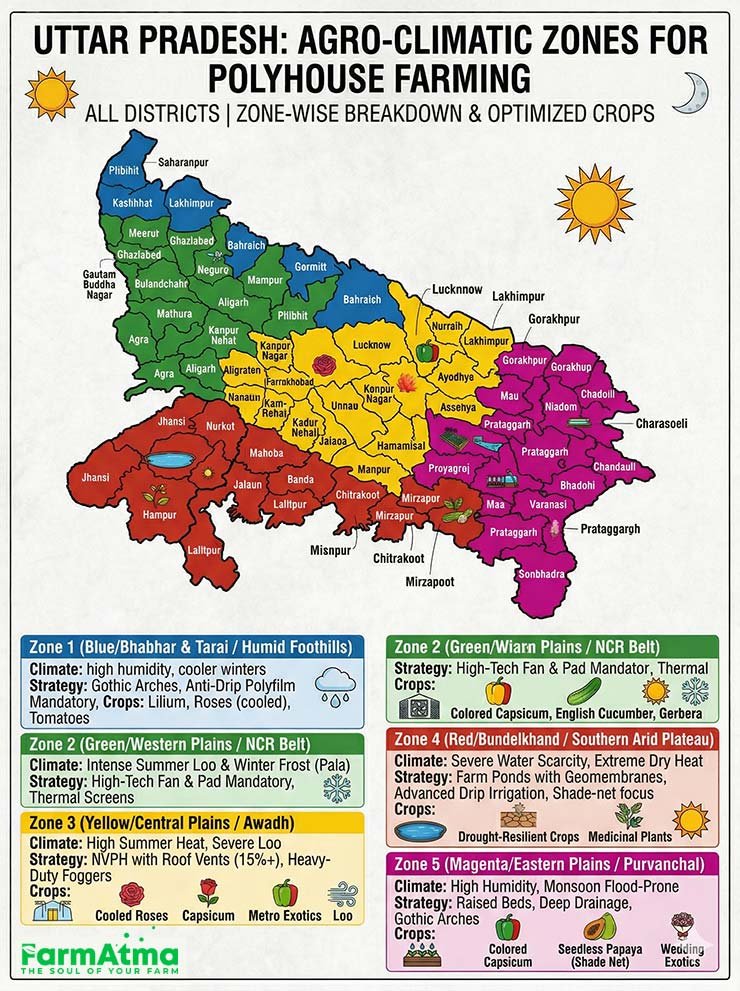
To maximize your ROI and protect your crop from the brutal summer “Loo” (dry winds) and winter “Pala” (frost), your structural design must match your specific district. Here is the strategic breakdown covering all 76 districts of UP:
1. Western UP (The NCR & Semi-Arid Belt)
- Districts Covered: Saharanpur, Shamli, Muzaffarnagar, Baghpat, Meerut, Ghaziabad, Hapur, Gautam Buddha Nagar (Noida), Bulandshahr, Aligarh, Kalyan Singh Nagar, Mathura, Hathras, Agra, Firozabad, Mainpuri, Etah, Kasganj, Sambhal.
- The Climate Challenge: Extreme diurnal variations. Blistering summer heat combined with severe, dense winter fog that blocks sunlight for weeks.
- Polyhouse Strategy: Because of the affluent Delhi/NCR market, High-Tech Fan & Pad (Climate-Controlled) Polyhouses are highly viable here. If building an NVPH (Naturally Ventilated), you must invest in automated thermal screens to prevent winter frost damage and overhead foggers for the summer. Read the Differences Between Different Polyhouse Structures.
- Top Profitable Crops: Parthenocarpic (Seedless) English Cucumber, Colored Capsicum, Cherry Tomatoes, and Gerbera. These cater directly to the premium Azadpur Mandi and Delhi HoReCa (Hotel/ Restaurant/ Café) sector.
2. Bhabhar & Tarai (The Northern Foothills)
- Districts Covered: Bijnor, Amroha, Moradabad, Rampur, Bareilly, Pilibhit, Shahjahanpur, Lakhimpur Kheri, Bahraich, Shravasti, Balrampur, Gonda.
- The Climate Challenge: High humidity, heavy monsoon rainfall, and cooler winters due to the proximity to the Himalayas.
- Polyhouse Strategy: The biggest threat here is fungal disease (like Downy Mildew and Botrytis) caused by high humidity. Structures require steep gothic arches to shed heavy rain and maximum side-ventilation. Anti-drip polyfilms are absolutely mandatory to prevent condensation from falling onto the crop canopy.
- Top Profitable Crops: High-yield Indeterminate Tomatoes, Dutch Roses, Lilium, and off-season leafy greens.
3. Central Plains & Awadh (The Doab)
- Districts Covered: Farrukhabad, Kannauj, Etawah, Auraiya, Kanpur Dehat, Kanpur Nagar, Unnao, Lucknow, Sitapur, Hardoi, Raebareli, Amethi, Barabanki, Ayodhya, Fatehpur.
- The Climate Challenge: The traditional heartland of UP experiences the fiercest summer “Loo” winds and highly variable monsoons.
- Polyhouse Strategy: Windbreak systems (tall boundary plantations or high-density shade nets on the perimeter) are crucial to block the burning Loo. Top-tier roof ventilation (minimum 10-15% of the total area) and heavy-duty fogging systems are required to artificially drop internal temperatures during May and June.
- Top Profitable Crops: Dutch Roses (with excellent cooling), Colored Capsicum, and premium vegetables targeted at the booming Lucknow and Kanpur metro markets.
4. Eastern UP (Purvanchal)
- Districts Covered: Sultanpur, Ambedkar Nagar, Azamgarh, Mau, Ballia, Deoria, Kushinagar, Gorakhpur, Maharajganj, Siddharthnagar, Basti, Sant Kabir Nagar, Pratapgarh, Prayagraj, Kaushambi, Jaunpur, Ghazipur, Varanasi, Chandauli, Bhadohi.
- The Climate Challenge: High humidity, slightly milder winters compared to the West, but significant flood-prone pockets during the monsoon. Freight costs for polyhouse materials are also slightly higher here.
- Polyhouse Strategy: Site selection is everything. Do not build in low-lying areas. The foundation and internal drainage systems must be heavily reinforced to handle monsoon runoff. Raised bed heights should be increased to protect the root zones from waterlogging.
- Top Profitable Crops: Colored Capsicum, Seedless Papaya (grown under specialized 50% Shade Nets to protect from viral vectors), and high-value traditional vegetables grown off-season to capture local wedding season demand in Varanasi and Gorakhpur.
5. Bundelkhand & Vindhyan (The Arid & Rocky Plateau)
- Districts Covered: Jhansi, Lalitpur, Jalaun, Hamirpur, Mahoba, Banda, Chitrakoot, Mirzapur, Sonbhadra.
- The Climate Challenge: Severe water scarcity, extreme dry heat, rocky soils, and drought conditions.
- Polyhouse Strategy: This is the most challenging zone for polyhouse farming. Massive farm ponds (rainwater harvesting) lined with geomembranes are mandatory before you even lay the greenhouse foundation. Advanced inline drip irrigation with exact EC/pH monitoring is non-negotiable to save water.
- Top Profitable Crops: Drought-resilient, short-cycle exotics. Muskmelon, medicinal plants, and hardened Tomato varieties perform best here, often heavily supported by shade net cultivation rather than full enclosed polyfilms in the summer.
Subsidy Application Process: Navigating UP Bureaucracy
Correct paperwork and following the due process is the key to get polyhouse subsidy in Uttar Pradesh. If your paperwork is misaligned, your subsidy file will stall at the district office. Here is the exact path:
Step 1: The Land Documents (The Khatauni)
In UP, the primary land record is the Khatauni (Record of Rights) and the Khasra. Your name must clearly be on the Khatauni. If the land is leased, you need a registered lease agreement (usually 7 to 10 years minimum) specifically stating permission for protected cultivation.
Step 2: The DHO & Online Application
Register on the UP Horticulture DBT portal. The most important official in your journey is the District Horticulture Officer (DHO). They process the files, verify the initial land status, and send the proposal to the state headquarters in Lucknow.
Step 3: Joint Inspection
Once your polyhouse is built, a joint inspection team (usually comprising the DHO, an agricultural engineer, and bank officials) will verify that you used BIS-certified materials before releasing the 50% back-ended subsidy.
Note: Read our detailed guidance on Polyhouse Subsidy Process. Different schemes, state-wise breakdown, required documents and step-by-step application process.
Directory of DHO Offices in Uttar Pradesh (2026)
1. Western UP (Meerut & Saharanpur Divisions)
| District | Office Location/ Address |
| Gautam Buddha Nagar (Noida) | Office of the DHO, Vikas Bhawan, Surajpur, Greater Noida – 201306 |
| Ghaziabad | Office of the DHO, Vikas Bhawan, Raj Nagar, Ghaziabad – 201002 |
| Meerut | Office of the DHO, Vikas Bhawan, Civil Lines, Meerut – 250001 |
| Hapur | Office of the DHO, Collectorate Compound, Hapur – 245101 |
| Bulandshahr | Office of the DHO, Vikas Bhawan, Bulandshahr – 203001 |
| Baghpat | Office of the DHO, Collectorate Compound, Baghpat – 250609 |
| Saharanpur | Office of the DHO, Vikas Bhawan, Delhi Road, Saharanpur – 247001 |
| Muzaffarnagar | Office of the DHO, Vikas Bhawan, Muzaffarnagar – 251001 |
| Shamli | Office of the DHO, Collectorate Compound, Shamli – 247776 |
2. Rohilkhand (Bareilly & Moradabad Divisions)
| District | Office Location/ Address |
| Bareilly | Office of the DHO, Mini Bypass, Rajatvihar Colony, FCI Colony, Alamgiri Ganj, Bareilly – 243005 (Standalone) |
| Budaun | Office of the DHO, Vikas Bhawan, Budaun – 243601 |
| Shahjahanpur | Office of the DHO, Vikas Bhawan, Shahjahanpur – 242001 |
| Pilibhit | Office of the DHO, Collectorate Compound, Pilibhit – 262201 |
| Moradabad | Office of the DHO, Vikas Bhawan, Civil Lines, Moradabad – 244001 |
| Amroha | Office of the DHO, Collectorate Compound, Amroha – 244221 |
| Bijnor | Office of the DHO, Vikas Bhawan, Bijnor – 246701 |
| Rampur | Office of the DHO, Vikas Bhawan, Rampur – 244901 |
| Sambhal | Office of the DHO, Collectorate Compound, Bahjoi, Sambhal – 244410 |
3. The Potato/Rose Belt (Aligarh & Agra Divisions)
| District | Hyper-Local Office Address & Pin Code |
| Agra | Office of the DHO, Vikas Bhawan, Sanjay Place, Agra – 282002 |
| Mathura | Office of the DHO, Vikas Bhawan, Mathura – 281001 |
| Firozabad | Office of the DHO, Vikas Bhawan, Dabrai, Firozabad – 283203 |
| Mainpuri | Office of the DHO, Collectorate Compound, Mainpuri – 205001 |
| Aligarh | Office of the DHO, Vikas Bhawan, Aligarh – 202001 |
| Hathras | Office of the DHO, Collectorate Compound, Hathras – 204101 |
| Etah | Office of the DHO, Vikas Bhawan, Etah – 207001 |
| Kasganj | Office of the DHO, Collectorate Compound, Kasganj – 207123 |
4. Central Awadh (Lucknow & Kanpur Divisions)
| District | Hyper-Local Office Address & Pin Code |
| Lucknow | Office of the DHO, Udhyan Bhawan, 2-Sapru Marg, Lucknow – 226001 (State HQ) |
| Unnao | Office of the DHO, Civil Lines, Kalyani, Unnao – 209801 (Standalone) |
| Hardoi | Office of the DHO, Vikas Bhawan, Hardoi – 241001 |
| Lakhimpur Kheri | Office of the DHO, Vikas Bhawan, Lakhimpur – 262701 |
| Raebareli | Office of the DHO, Vikas Bhawan, Raebareli – 229001 |
| Sitapur | Office of the DHO, Vikas Bhawan, Sitapur – 261001 |
| Kanpur Nagar | Office of the DHO, Vikas Bhawan, Rawatpur, Kanpur – 208002 |
| Kanpur Dehat | Office of the DHO, Vikas Bhawan, Mati HQ, Akbarpur – 209304 |
| Etawah | Office of the DHO, Vikas Bhawan, Etawah – 206001 |
| Farrukhabad | Office of the DHO, Collectorate Compound, Fatehgarh – 209601 |
| Kannauj | Office of the DHO, Collectorate Compound, Kannauj – 209725 |
| Auraiya | Office of the DHO, Collectorate Compound, Kakhal, Auraiya – 206122 |
5. The Tarai & East Awadh (Ayodhya, Devipatan & Basti Divisions)
| District | Hyper-Local Office Address & Pin Code |
| Ayodhya | Office of the DHO, Vikas Bhawan, Ayodhya – 224001 |
| Ambedkar Nagar | Office of the DHO, Collectorate Compound, Akbarpur – 224122 |
| Barabanki | Office of the DHO, Vikas Bhawan, Barabanki – 225001 |
| Sultanpur | Office of the DHO, Vikas Bhawan, Sultanpur – 228001 |
| Amethi | Office of the DHO, Collectorate Compound, Gauriganj – 227409 |
| Gonda | Office of the DHO, Vikas Bhawan, Gonda – 271001 |
| Bahraich | Office of the DHO, Vikas Bhawan, Bahraich – 271801 |
| Shravasti | Office of the DHO, Collectorate Compound, Bhinga – 271831 |
| Balrampur | Office of the DHO, Collectorate Compound, Balrampur – 271201 |
| Basti | Office of the DHO, Vikas Bhawan, Basti – 272001 |
| Siddharthnagar | Office of the DHO, Vikas Bhawan, Naugarh – 272202 |
| Sant Kabir Nagar | Office of the DHO, Collectorate Compound, Khalilabad – 272175 |
6. Purvanchal (Gorakhpur, Azamgarh & Varanasi Divisions)
| District | Hyper-Local Office Address & Pin Code |
| Gorakhpur | Office of the DHO, Vikas Bhawan, Gorakhpur – 273001 |
| Deoria | Office of the DHO, Vikas Bhawan, Deoria – 274001 |
| Kushinagar | Office of the DHO, Ravindra Nagar Dhoos, Padrauna – 274304 |
| Maharajganj | Office of the DHO, Vikas Bhawan, Maharajganj – 273303 |
| Azamgarh | Office of the DHO, Vikas Bhawan, Azamgarh – 276001 |
| Ballia | Office of the DHO, Vikas Bhawan, Ballia – 277001 |
| Mau | Office of the DHO, Room 13/14, Vikas Bhawan, Mau – 275101 |
| Varanasi | Office of the DHO, Vikas Bhawan, Kutchery Road, Varanasi – 221002 |
| Jaunpur | Office of the DHO, Vikas Bhawan, Jaunpur – 222002 |
| Ghazipur | Office of the DHO, Vikas Bhawan, Ghazipur – 233001 |
| Chandauli | Office of the DHO, Collectorate Compound, Chandauli – 232104 |
7. Bundelkhand & Vindhyan (Prayagraj, Mirzapur, Jhansi & Chitrakoot Divisions)
| District | Hyper-Local Office Address & Pin Code |
| Prayagraj | Office of the DHO, Vikas Bhawan, Prayagraj – 211001 |
| Fatehpur | Office of the DHO, Vikas Bhawan, Fatehpur – 212601 |
| Pratapgarh | Office of the DHO, Vikas Bhawan, Pratapgarh – 230001 |
| Kaushambi | Office of the DHO, Vikas Bhawan, Manjhanpur – 212207 |
| Mirzapur | Office of the DHO, Vikas Bhawan, Mirzapur – 231001 |
| Sonbhadra | Office of the DHO, Collectorate Compound, Robertsganj – 231216 |
| Bhadohi | Office of the DHO, Collectorate Compound, Gyanpur – 221304 |
| Jhansi | Office of the DHO, Vikas Bhawan, Jhansi – 284001 |
| Jalaun | Office of the DHO, Vikas Bhawan, Orai – 285001 |
| Lalitpur | Office of the DHO, Vikas Bhawan, Lalitpur – 284403 |
| Banda | Office of the DHO, Vikas Bhawan, Banda – 210001 |
| Chitrakoot | Office of the DHO, Collectorate Compound, Karwi – 210205 |
| Mahoba | Office of the DHO, Collectorate Compound, Mahoba – 210427 |
| Hamirpur | Office of the DHO, Vikas Bhawan, Hamirpur – 210301 |
Target Markets: Where to Sell Polyhouse Produce in UP
Uttar Pradesh is strategically located and has very good market access for high-value polyhouse produces. Below are best markets in UP.
- Azadpur Mandi (Delhi): The ultimate destination for Western UP farmers. It sets the benchmark pricing for English Cucumber and Capsicum across North India.
- Ghazipur Flower Mandi (Delhi/UP Border): The primary liquidation hub for floriculture projects.
- Naveen Galla Mandi (Lucknow & Kanpur): The biggest consumption hubs for Central UP.
- Direct to Hotel/HoReCa: If you are near Agra, Varanasi, or Noida, bypass the mandis entirely. Tie up directly with 5-star hotels and premium catering services that need daily exotic supplies.
The Brutal Truth: Why UP Polyhouses Fail
Projects in UP do not fail because of a lack of demand. They fail because of Climate Ignorance.
Many farmers build a basic NVPH to save money, plant English Cucumbers in April, and watch their entire crop collapse when the May “Loo” pushes the internal temperature to 50°C. Conversely, they lose their winter crop when January fog blocks the sun for 15 straight days, causing massive fungal outbreaks.
Expert Insight:
Here is the unspoken reality of the UP greenhouse industry: A polyhouse designed for the mild hills of Pune is a death trap in the plains of Awadh. Unscrupulous contractors will gladly sell you a cheap, generic structure without properly sizing the exhaust fans or high-pressure foggers for a 48°C summer afternoon. When the “Loo” hits and your crop boils, the vendor is already gone, but your bank EMI remains. To survive the brutal extremes of Uttar Pradesh, you cannot outsource your climate engineering to a steel salesman. You must step up as the CEO of your farm. That means knowing exactly how to audit a cooling pad calculation and cross-check your winter thermal screen specs before you hand over a single rupee.
The Blueprint for Success
To succeed in UP, you must know how to calculate your cooling pad requirements, size your exhaust fans, and build a bank-approved Detailed Project Report (DPR) that factors in winter heating/fogging costs.
Don’t guess your ROI or let a vendor dictate your structure.
Get the exact blueprints, UP-specific DPR templates, and our ruthless vendor-negotiation checklists inside the Commercial Polyhouse Masterplan.