
Is Polyhouse Farming in India the “Crorepati” business model everyone claims?
Polyhouse farming in India is rapidly gaining popularity as the ultimate solution for farmers looking to generate huge profits from a small piece of land. It is widely considered the future of modern agriculture.
Unlike traditional open-field farming, Polyhouse cultivation (also known as Protected cultivation) allows you to grow crops in a fully controlled environment. By regulating critical factors like temperature, humidity, and sunlight, you are no longer at the mercy of the weather.
The result? You drastically reduce pests and diseases while producing superior quality crops. Because the plants are shielded from external pollution and require significantly fewer pesticides, the produce is cleaner, uniform in shape, and healthier.
This allows you to achieve the “Holy Grail” of farming: harvesting high-value crops (like Colored Capsicum and Dutch Roses) during the off-season when market prices are at their peak.
But is it right for you? This guide covers the A to Z of the Polyhouse Business, from construction costs to daily management, ensuring you treat your farm like a profitable factory, not just another farm.
Crops Grown in Polyhouse Farming
Many crops can be grown in a polyhouse but farmers should calculate the ROI (Return on Investment) and Risk-Reward Ratio when selecting a crops for growing in a polyhouse as the construction cost of a polyhouse is quite high. Cut flowers, high value vegetables, some fruits and disease free planting materials are best suited for polyhouse/ greenhouse cultivation. Here are some crops grown in polyhouse farming.
VEGETABLES (Protected Cultivation)

Capsicum

Cucumber

Tomato
FLOWERS (Protected Cultivation)
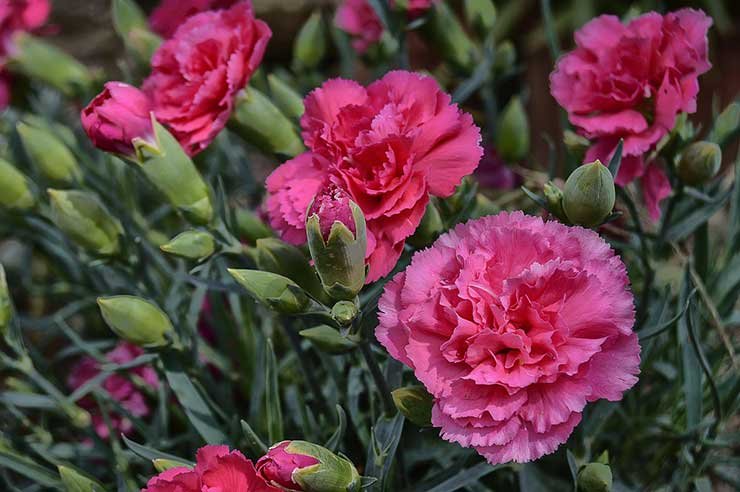
Carnation

Gerbera

Lilium

Rose
How to Start Polyhouse Farming: The Roadmap (Timeline)
Setting up a commercial polyhouse is a long-term project. It typically takes 6 to 9 months from planning to planting. Do not rush the paperwork steps, or you risk losing your subsidy.
Here is the step-by-step process:
Phase 1: Planning & Documentation (Month 1 – 2)
- STEP 1: Site Selection: Ensure the proposed land is level, has road access, and electricity.
- STEP 2: Soil & Water Testing: Essential. If water EC > 1.0, you need an RO plant.
- STEP 3: Get Quotations: Contact 3-4 vendors for structure cost estimates.
- STEP 4: Prepare DPR: Create a “Detailed Project Report” based on the vendor quotes and your crop selection.
👉 Resource: Download Bank-Ready DPR Template
Phase 2: Funding & Approvals (Month 3 – 5)
- STEP 5: Bank Sanction: Submit DPR to the bank. Get the Term Loan sanction letter.
- STEP 6: NHB Application: Apply online for the “In-Principle Approval” (IPA) from the National Horticulture Board.
- STEP 7: Wait for LOI: Do not start construction until you receive the Letter of Intent (LOI) from NHB.
👉 Resource: NHB Subsidy Application Guide
Phase 3: Construction (Month 6 – 8)
- STEP 8: Civil Work: Foundation, control room, and water tank construction.
- STEP 9: Structure Erection: GI pipe installation and plastic cladding.
- STEP 10: Irrigation Setup: Installation of drip lines, foggers, and automation units.
👉 Resource: Fan & Pad vs. NVPH Structure Guide
Phase 4: Operational Setup (Month 8 – 9)
- STEP 11: Bed Preparation: Mixing soil with FYM, Cocopeat, and Basal Dose fertilizers.
- STEP 12: Soil Sterilization: Treating the soil (chemical or solarization) to kill pests before planting.
- STEP 13: Plant Booking: Order saplings from a tissue culture lab (book 3 months in advance).
Phase 5: Farming Begins (Month 9 onwards)
- STEP 14: Plantation: Transplaning the saplings into the beds.
- STEP 15: JIT Inspection: Call the government inspection team to release your subsidy.
- STEP 16: First Harvest: Usually starts 60-90 days after planting (depending on the crop).
👉 Resource: Profitability Guide for First Crop
Polyhouse Construction Cost (2026 Estimates)
“How much money do I need?” This is the biggest question in polyhouse farming.
The cost depends heavily on the structure type (Fan & Pad vs. Naturally Ventilated) and automation.
Quick Estimates (Per Sq. Meter):
| Type | Cost Per Sq. Meter | Best For |
| Naturally Ventilated (NVPH) | ₹800 – ₹950 | Moderate Climates (Pune, Bangalore) |
| Fan & Pad (Semi-automatic) | ₹1,600 – ₹2,000 | Hot Climates (Rajasthan, Gujarat) |
| Net House | ₹350 – ₹550 | Low Budget / Dry Areas |
Note: These are base rates. Read the Full Cost Breakdown – See itemized costs for Steel, Drip, and Labor in our detailed guide.
Government Subsidy (The 50% Scheme)
You don’t have to pay for the whole project yourself. The National Horticulture Board (NHB) offers massive financial support to encourage modern farming.
- Polyhouse Subsidy Rate (2026): Flat 50% on project cost.
- State Top-Ups: States like Haryana and Telangana offer extra, taking the total to 65-95%.
- The Golden Rule: The subsidy is Credit-Linked. You must take a bank loan to be eligible. You cannot self-finance.
Warning: Starting construction before getting the “Letter of Intent” (LOI) will disqualify you. You must follow due process.
Financing the Dream: Bank Loans & Funding
The biggest myth in polyhouse farming is that you need ₹40 Lakhs in cash to start. You don’t. You only need to arrange 25% (Margin Money). The bank finances the remaining 75%.
However, getting an agriculture loan sanctioned is not as easy as getting a car loan. It requires a “Bankable” proposal.
The Two Loans You Need: Smart farmers don’t just take one loan; they structure their debt into two parts to manage cash flow better:
- 🏗️ Agriculture Term Loan (ATL):
- Purpose: For Construction (Steel, Plastic, Civil work).
- Tenure: 7 to 9 years.
- Moratorium: usually 1 year (You don’t repay principal for the first year).
- 💳 Kisan Credit Card (KCC):
- Purpose: For Working Capital (Seeds, Fertilizers, Labor).
- Benefit: Low interest rate (effective 4% with timely repayment). This ensures you don’t run out of cash mid-crop.
The “Collateral” Reality Check:
Unlike Mudra loans, Polyhouse loans are Secured Loans.
For any loan above ₹1.60 Lakhs, banks will mandate Collateral Security (Mortgage). You usually need to mortgage land or property worth 100% to 150% of the loan value.
Note: The land on which the polyhouse is built is the “Primary Security,” but banks often ask for “Additional Collateral.”
Don’t Go Empty-Handed
Most loan applications are rejected because of a weak Detailed Project Report (DPR). If your projected “Debt Service Coverage Ratio” (DSCR) is below 1.5, the manager will say no.
Want the sanction letter in 15 days? We have listed the exact “File Checklist” (Set A, B, and C documents) you need to prepare before visiting the branch.
Types of Polyhouse: Which One for You?
Do not copy your neighbor. Your structure depends on your local climate and your crop choice.
- Naturally Ventilated Polyhouse (NVPH): Uses roof vents to circulate air. Zero electricity cost. Best for 70% of Indian farmers.
- Fan and Pad Polyhouse: Uses exhaust fans and wet cooling pads. Acts like a giant desert cooler. Essential for hot states like Rajasthan but has high electricity bills.
- Net House: Uses shade nets. Cheaper but offers no protection against rain or heavy pests.
Confused?
See our “State-Wise Recommendation Map” to choose the right one.
Best Crops for High Profit
You already know which crops can be grown in a polyhouse from the crop list at the beginning. A polyhouse is useless if you grow low-value crops like Wheat or regular Tomato. You must grow crops that command a premium price and give better ROI to recover the polyhouse investment quickly.
Top 5 Crops for Polyhouse:
| 🌱Crop | 🧠 Difficulty Level | 💰 Est. Annual Profit (Net) | 🎯 Best For… |
| Colored Capsicum | ⭐⭐ (Easy) | ₹8 – ₹12 Lakhs | Beginners (Stable Market) |
| Cucumber (Seedless) | ⭐⭐ (Easy) | ₹6 – ₹9 Lakhs | Cash Flow (Daily Harvest) |
| Dutch Roses | ⭐⭐⭐⭐⭐ (Hard) | ₹12 – ₹18 Lakhs | Experts (Export Linkage Required) |
| Gerbera | ⭐⭐⭐ (Medium) | ₹8 – ₹12 Lakhs | Decoration Market |
| Cherry Tomato | ⭐⭐⭐ (Medium) | ₹6 – ₹10 Lakhs | Contract Farming |
What should YOU grow?
Compare the Yield, Price, and Risk of the top 5 crops.
Check Polyhouse Subsidy & Cost in Your State
Government norms, freight costs, suitable crops, and weather challenges vary wildly across India. Select your state below to read our highly localized 2026 master guides.
Understanding Polyhouse Technology in Detail
What is a Polyhouse?
A polyhouse is a type of protected cultivation structure that is covered with UV stabilized polythene to create an artificial climate inside the structure and help grow crops under optimum conditions.
Principle of a Polyhouse
Polyhouse is only a type of protected cultivation structure among many. The main principle of a polyhouse is to capture the greenhouse gas inside the structure. As greenhouse or polyhouse is made of transparent glass or polythene cover where interiors grow warmer when exposed to sunlight as the cover blocks the greenhouse gas to exit. Therefore, while it may be cold outside the temperature is survival friendly and warm for the plants growing inside. Some greenhouses using high-end technology have installed equipment like heating and cooling system, lighting, screening installations and even computerized facilities to provide optimal growth conditions for the plants. This is done especially to reduce the risks of crop loss in greenhouse cultivation.
Difference Between Polyhouse and Greenhouse
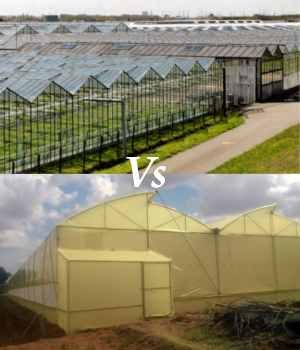
All types of protected cultivation structure is commonly known as greenhouse for their ability to create a greenhouse effect artificially by controlling the interior environment. A polyhouse is a type of greenhouse structure where UV stabilised polyethylene is used as the cover material.
A. Greenhouse: A greenhouse is made of some kind of transparent material to create a microclimate inside the house. Different materials like glass, wood, polyethylene etc. are used as greenhouse cover to create the microclimate. When a greenhouse is made with glass cover it is referend as glass greenhouse or glass house.
B. Polyhouse: A polyhouse is one type of greenhouse where polyethylene is used as the cover. In India, polyhouse farming is the most popular greenhouse technology for it’s high availability and lower cost of construction. Lath house is another greenhouse technology where wood is used as the cover.
Poly house is economical compared to glass house or glass greenhouse but the later is more durable than polyhouse and is more suitable in cold places where it snows.
Types of Greenhouse
There are different types of greenhouses according to cost, shape, structure type, construction material, glazing type and environmental control. Farmers should choose a greenhouse type as per their particular needs and investment capacity.
1. Greenhouse Types Based on Cost and Suitability
A. Low Cost Greenhouse/ Bamboo Greenhouse
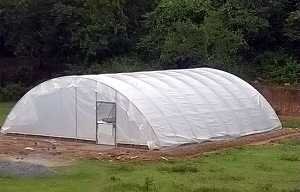
As the name suggests, low cost polyhouse is constructed using locally available materials like bamboo. The light intensity is controlled using shade nets. UV stabilized polyethylene film is used for covering. Simple techniques like side wall opening or closing is used for controlling temperature during summer and winter. They serve as good shelters for rain. This type of structure does not have high technology facilities and is mainly used in places with cold climatic conditions. Marginal farmers with small land holdings can take the benefits of greenhouse farming using low cost bamboo polyhouse.
B. Semi-Automatic Greenhouse
Some greenhouses are partially controlled with minimum investment conditions. Pipes made of galvanized iron are used for the construction and the canopy is held together with the help of screws. It is lodged firmly in the ground to withstand the wind. There are exhaust fans with thermostat system to control the temperature. There are also cooling pads and arrangements for misting to maintain humidity levels. Such structures are suitable for areas with dry and composite climate. This type of polyhouse is the most popular greenhouse structure farming in India.
C. High-End Greenhouse
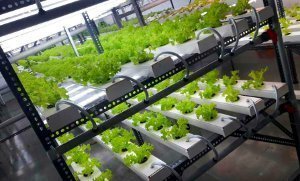
These structures are installed with polyhouse automation devices to control temperature moisture, humidity and other environmental parameters. This type of polyhouse is used for very high value crops and hydroponics projects in commercial greenhouse farming.
You should consider high-end greenhouse only when the selected crops demand it and when the project is located in urban area where the manpower cost is very high. ROI must be calculated before choosing this type of polyhouse.
2. Greenhouse Based on Structure Types
There are 4 types of greenhouses in this category:
- Quonset type
- Curved roof type
- Gable roof type
- Sawtooth type
The main category of classification is based on the type of material used for support such as PVC frames, steel supports, etc.
3. Greenhouse Based on Glazing
This classification is based on the type of material used for covering the structure. They maybe:
- Fiberglass reinforced plastic glazing
- Glass glazing
- Plastic film
The material used for fiberglass reinforced plastic glazing can be plain sheet or corrugated sheet. The plastic film used is UV stabilized low density polyethylene. This is the most popular covering material for polyhouse farming in India.
4. Polyhouse Based on Number of Spans
- Single span
- Ridge and furrow
5. Polyhouse Based on Environmental Control
A. Naturally Ventilated Polyhouse (NVPH)
The structures have good ventilation systems to prevent basic weather and natural damage. However, they do not have any additional provisions to control the environment in polyhouse farming.
B. Environmentally Controlled Polyhouse
This type of greenhouse is basically constructed for off-season production. Factors like light, temperature, carbon dioxide levels, humidity, etc. are controlled.
Polyhouse Design
A polyhouse is designed based on environmental conditions of the site and those required for plant growth in polyhouse farming. Taking into consideration the Indian climatic conditions, multi-span, Quonset type greenhouse is the most preferred. It is economical and can be easily constructed. For naturally ventilated greenhouses low density polyethylene films stabilized under UV is used. Some people also use films having a thickness of 200 microns. Screws and nails are not used since the films may get torn off. Instead, they are fastened using T-lock or L-lock. While designing the greenhouse it should be remembered that the structure must bear different types of loads like:
- Dead Load- It is the weight of all the equipment fixed on the frame such as water pipes, service equipment, heating and cooling systems, cladding and the weight of permanent constructions.
- Live Load- A greenhouse is devised to carry a maximum weight of 15 Kg per square meter. In addition, the roof members must be capable of supporting shelves, hanging baskets, people, etc.
- Wind Load- The structure must have the capacity to withstand 50Kg per square meter of wind pressure.
- Snow Load- This is considered in areas having snowfall. In case of snow fall, the structure must be able to bear all the different loads in addition to the snow load.
Components of a Polyhouse
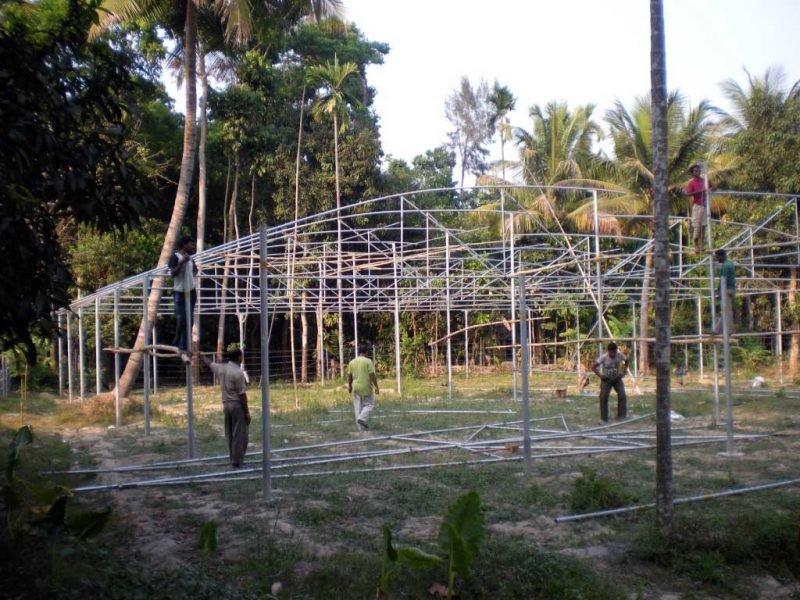
A polyhouse is made of multiple components. The different components of a polyhouse are
- Roof- It is the transparent overhead cover of the greenhouse.
- Gable- The wall of the greenhouse is called gable which is transparent.
- Gutters- Gutters collect and drain out the snow and rain water that is gathered between the spans.
- Column- It is vertical structure that carries the greenhouse.
- Ridge- It is the horizontal section on top of the roof.
- Bracings- Bracings are erected to support the structure against wind.
- Arches- They are the structures that support the covering materials.
- Foundation Pipe- Foundation pipes connect the structure to the ground.
Orientation of Polyhouse
The orientation of a polyhouse depends on the shadow movement, shading effect, type of temperature control, wind direction and latitude. In case of other polyhouses nearby, the orientation should be such that its shadow does not fall on other greenhouses. For this purpose, they are oriented in an East to West direction.
Dimensions
To decide the dimensions, a host of factors like size of the polyhouse, wind effects, height, spacing between the greenhouses and its structural design must be considered.
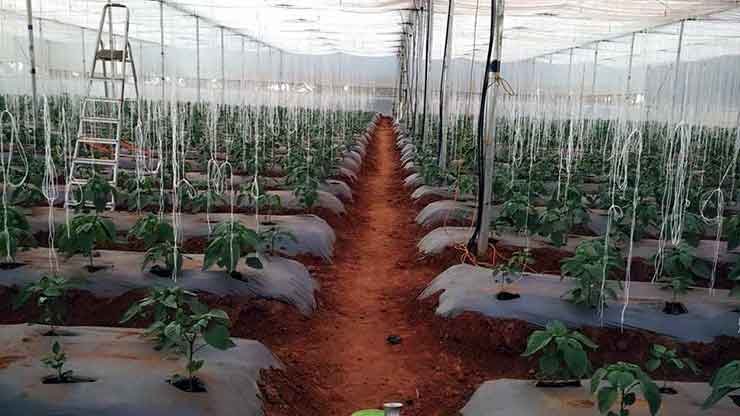
- Wind effects: The length of the polyhouse must be perpendicular to the direction of the wind. In case of fan and pad arrangement, the direction of natural wind must be the same as that of the air blown by the fan.
- Size of polyhouse: A bigger polyhouse would have more temperature build-up especially if there is no proper ventilation. In case of naturally ventilated greenhouse, the length must not exceed 60m.
- Spacing between polyhouses: There should be a distance of 10-15m between two polyhouses. This is to avoid shadow from falling on each other. In addition, the exhaust from one polyhouse greenhouse must not enter the other polyhouse.
- Height: A 50m X 50m polyhouse can attain a maximum height of 5m. A taller polyhouse would have larger wind load for the glazing and structure.
- Structural design: The structure of the polyhouse must be able to bear all the different loads. Hence, the column, foundation and truss must be designed accordingly. They must follow the guidelines specified by the National Greenhouse Manufacturers Association (NGMA of US) standards.
Cladding Materials for Greenhouse Farming
Cladding is nothing but covering of the greenhouse. There are different materials used for cladding a greenhouse such as polycarbonate, polyethylene, fiberglass, UV stabilized polyethylene films and Tedlar coated fiberglass. Double strength glass and polycarbonate have a durability of 50 years and require very low maintenance. Polyethylene films in polyhouse require high amount of maintenance but are durable for only 3-5 years. Fiberglass is durable for seven years while Tedlar coated fiberglass can sustain upto 15 years.
Containers for Greenhouse Farming
Different types of containers are used in a greenhouse for different purposes like growing plants under controlled climatic conditions, raising the seedlings, growing plants for hybrid seed production and for growing ornamental plants in pots. Using containers increase capacity of the production while reducing the crop time in polyhouse farming. Containers ensure uniform growth of plants and minimum transplantation shock. In addition, it eases monitoring of plants and plant nutrition.
Here is a table with different types of containers used in polyhouse farming along with their advantages and disadvantages:
| Types of Containers | Advantages | Disadvantages |
|---|---|---|
| Clay Pot | Easy water managements and very low cost. | Pots are heavy to handle and they dry fast. |
| Single Peat | Root penetration is very good. | Difficult to separate. |
| Single Peat Pallet | Storage requirement is low. | Since the sizes are very limited, they require individual handling. |
| Soil block and band | It facilitates excellent root penetration. | While blocks demand heavy machinery, managing a band is intense labour. |
| Strip Peat Pot | Root penetration is very good. | Separation is slow. |
| Pre-Spaced Peat Pallet | Small sized containers. Do not require media preparation. | Since sizes are small, they require individual handling. |
| Pot | Easy to handle in field. Available in all sizes and shapes. | Difficult to separate. |
| Fibre block | They are easy to handle. | They have a shorter life. In addition, the root penetration is difficult. |
| Fibre trays | They use minimum space. | They are hard to handle when wet. |
| Polyurethane foam | They are easy to handle and reusable. | Using this container needs regular fertilization. |
Watering System in Polyhouse Farming
Drip irrigation is the best technique for watering the plants owing to the small root system. It must be ensured that the water is dispersed at the root area only and that it does not fall on the leaves or flowers. Falling on leaves and flowers may lead to infection, disease spread and even scorching. Water is forced out through the nozzles under very high pressure through the micro-sprinklers. These sprinklers are arranged at a height of 1 foot above ground level so as to ensure that water is dispersed at the basal part of the plants.
Maintenance of Greenhouse
The chief expense of greenhouse is the maintenance of the transparent films. The biofilm on the walls and roof must be washed periodically since dust settles on them reducing the light transmittance. The greenhouse must be solarized annually. Solarization is done by mulching and the interiors are fumigated. Biological control of insects or installation of insect traps is mandatory in greenhouse agriculture. The pipes and sprinklers of the irrigation system must be cleaned periodically so as to prevent accumulation of microbes that may lead to infection in plants. If following organic farming then extra care should be taken.
Problems in Greenhouse Farming
Since plants are being cultivated under controlled climatic conditions in a greenhouse, it has its own share of problems too. One of the chief problems is ensuring nutrient availability and protecting the plants from deficiency of various minerals like boron, nitrogen, phosphorous, calcium, iron and potassium. Similarly, plants may also suffer from excess of nutrients. Constant monitoring and soil testing is necessary to ensure that the plants get adequate amount of nutrition and grow properly.
Site Selection for Greenhouse Construction
In its early years, the aim of a greenhouse was to grow species that require heat in colder regions. It was easier to control climatic factors like temperature and moisture level inside a greenhouse and protect the plants from the harsh external cold winds. In India, the following points are to be considered for selecting the place to set up a poly greenhouse:
- Water Logging: The site must be a well-drained area and not a place that has water logging issues. Water logging can cause potential harm to the crops especially in areas with heavy rainfall and floods.
- Pollution: The greenhouse must not be built near industrial units. This is to protect the crops from possible pollution effects.
- Accessibility: Although it should not be placed very near the roads, yet, they must be easily accessible through various modes of transport.
Frequently Asked Questions (FAQ)
Q1: Is Polyhouse farming really profitable in India?
Answer: Yes, but only if treated as a business. A well-managed 1-acre polyhouse growing Colored Capsicum can generate a Net Profit of ₹8 Lakhs to ₹12 Lakhs per year. However, this requires strict climate control and direct marketing. If you rely solely on middlemen or neglect the technical parameters, you can face losses.
Q2: What is the minimum land required for a commercial project?
Answer: While you can build a polyhouse on 500 sq. mtr, for a project to be commercially viable, we recommend a minimum of 1 Acre (4,000 Sq. Mtr).
Reason: Smaller units have high “Overheads per Kg” (Manager salary, Security, Transport), making it hard to compete with larger farms on price.
Q3: Can I get a 100% subsidy?
Answer: No. The central government scheme (NHB) offers a maximum 50% subsidy. Some specific state schemes (like in Himachal or for SC/ST categories in certain states) might push this to 80-90%, but these are rare and have limited funds. You should plan your finances assuming a 50% grant.
Q4: Why do many polyhouse farmers fail?
Answer: The #1 reason for failure is Lack of Technical Knowledge. Many farmers treat a polyhouse like an open field—watering indiscriminately and ignoring humidity levels. This leads to fungal diseases. The second reason is Poor Market Linkage—harvesting a premium crop but selling it at regular mandi rates.
Q5: Can I manage a polyhouse part-time?
Answer: No. Polyhouse farming is an intensive activity. It requires daily monitoring of EC/pH levels, pest scouting, and irrigation cycles. If you have a full-time job, you must hire a trained Agronomist or Farm Manager to live on-site.
Q6: Which crop is best for beginners?
Answer: Colored Capsicum (Bell Pepper) is the safest bet for new farmers. It has a stable market demand, is less sensitive than roses, and offers a good balance of yield vs. price.
Conclusion: Is Polyhouse Farming Your Future?
The popularity of greenhouse farming is increasing in India and all around the world because it solves the biggest problem farmers face: Unpredictability.
Yes, you can make a huge profit from polyhouse cultivation compared to traditional farming, but only if you treat it as a business, not a hobby. The ecosystem is ready for you—Horticultural departments and state governments are actively providing subsidies to encourage this technology.
The money is there. The market is there. The only missing piece is your plan. We at FarmAtma are ready to guide you step-by-step holding your hand to become an agri-entrepreneur from a regular farmer.
🚀 Ready to take the first step?
Don’t guess your budget.
👉 Plan Your Project Cost (2026 Rates) – Make a budget for your polyhouse project.
👉 Check Your Subsidy Eligibility – Read the step-by-step application process and document list.
Myself Abhilash Kumar I from Mysore and I am interested in agriculture I have 6 acre land in Mysore
6 Acres is a good amount of land for commercial agriculture. You may buy our project reports to learn about detailed economics on different farming projects and choose one.
Hey. I’ve got some land in Haryana that I would like to use for Hydroponics farming for Saffron cultivation. I read your saffron report from earlier and found there is some possibility of doing it. Is there any way you can help by the way of consulting on the project?
Which state recently introduced greenhouse farming
I am interested in poly house.I don’t have a land and I have to rent the land for this purpose.Do i get subsidy if I go for the rent?
To establish polyhouse farming
In Malda District.West Bengal.pin 732101
i want construct one poly house half acre area and how much cost
I want to put poly house in 2L sqft. Pl guide
Explain me in detail please I am farmer’s son and I want polyhouse farming in my field.
Thankyou.
Regards–>Bharat Chawda
Please share the details
Would like to construct polyhouse in 1 acre with fully autometic
Would like to contact you pls share your contact details.
call me
I want to start poly house farming in 1 acre land in Jhajjar district of Haryana . Please shares all details and expenditures in building a fresh poly house in 1 acre of land
Regarding Poly House
We are planning to build a polyhouse on 6 acres near RGI Airport. Please contact us for further discussion
Want establish polyhouse in 6 guntha
I want to start a poly house farming in 1 acre of land in Jhajjar district of Haryana .Please provide all details and expenditures.
Meri bhi rajasthan me jameen hai muje ye Polly house karna hai guide kare
I want to start a poly house farming in 1 acre of land in prayagraj .Please provide all details and expenditures.
I want to plan polyhouse 10 guntha plz guide me.