
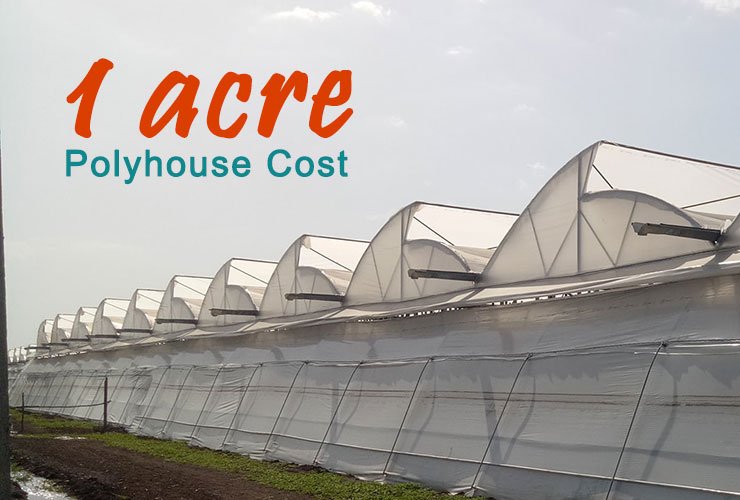
Polyhouse cost ranges from Rs. 800 per sq. mtr. for a low-cost polyhouse to Rs. 2500 per sq. mtr. for a fully automatic hi-tech polyhouse. Generally, the polyhouse construction rate is calculated per square metre. In India, the metal structured Naturally Ventilated polyhouse cost per acre is Rs. 32,00,000 – Rs. 38,00,000.
Quick Estimates: Polyhouse Cost Per Sq. Meter (2026)
| Polyhouse Type | Cost Range (Per Sq. Meter) | Cost (Per Acre Approx.) |
| Naturally Ventilated (NVPH) | ₹800 – ₹950 | ₹32 – ₹38 Lakhs |
| Fan & Pad (Medium-Tech) | ₹1,600 – ₹2,000 | ₹60 – ₹75 Lakhs |
| Net House (Shade Net) | ₹350 – ₹550 | ₹14 – ₹18 Lakhs |
Note: These costs include structure, irrigation, machinery, and installation but exclude land cost.
Detailed Cost Breakdown: Where Does the Money Go?
Yes, ₹30 Lakhs sounds like a lot for 1 acre. But you aren’t building a shed; you are building a factory for crops. There are three different types of costs involved in polyhouse farming-
- STAGE1: Polyhouse Construction Cost (CAPEX- One-time investment)
- STAGE2: Polyhouse Farming Cost (Working Capital- From Day 1 of planting until the first harvest)
- STAGE3: Polyhouse Maintenance Cost (OpEx- The running cost and maintenance)
In this guide, we break down every single rupee—from the foundation pipe to the irrigation drip—so you know exactly where your money goes. Here is how the cost is distributed:
- 🏗️ The Skeleton (GI Structure): ~45-50% of cost.
- A 1-acre polyhouse requires roughly 30-35 tons of steel. Using B-Class Galvanized Iron (GI) pipes.
- FarmAtma Tip: “Don’t compromise here. Cheap steel rusts in 3 years.”. Ensure your vendor uses 2mm thickness pipes. Cheaper 1.5mm pipes may buckle under high wind velocity.
- ⛺ The Skin (Cladding Material): ~15% of cost.
- 200 Micron UV Stabilized Plastic Film (Usually 5-layer).
- Insect Nets (40 mesh for general, 50 mesh for smaller pests like thrips).
- 💧 The Life Support (Irrigation & Fertigation): ~15% of cost.
- Drip lines, Foggers/Misters (for humidity control).
- Filtration unit (Sand/Disc filters).
- 🧱 Civil Work & Bed Preparation: ~10% of cost.
- Foundation cement concrete.
- Bed preparation with soil mixture (FYM, Cocopeat, Basal dose).
- 🛠️ Labor & Installation: ~10% of cost.
Polyhouse Construction Cost per Acre
The major cost involved in polyhouse cultivation is the initial cost of setting up the polyhouse structure and other ancillary costs. Polyhouse construction costs vary based on steel prices (GI pipes) used for the structure and location (transport). Below is a list of indicative costs of different types of polyhouse in India. The costs can increase 12-15% in hilly areas.
| Polyhouse | Specifications | Standard Cost |
|---|---|---|
| High-Tech Automatic Polyhouse | Fully automatic IoT/sensor based climate controlled polyhouse including but not limited to soil sensors, temperature/ humidity sensors, Lux Meter, automatic drip irrigation, automated fertigation and remote monitoring. Increases yield 15-20% over medium tech polyhouse. | Rate: Rs. 1,800-2,500+/sq. mtr. Cost per acre: Rs. 72 Lakh – 1 Crore+ |
| Medium Tech Fan & Pad Polyhouse | Semi-automatic medium tech metal structured polyhouse with manual climate control using fan and pad. It has all the cooling/watering equipment, but a human must decide when to turn it on (timer-based or manual buttons). You need a farm manager present 24/7. | Rate: Rs. 1,375-1,600/sq. mtr. for single cladding and Rs. 1,600-2,000/sq. mtr. for double cladding (Inflated Double Poly) Cost per acre: Rs. 55-60 Lakh for single cladding and Rs. 60-75 Lakh for double cladding |
| Naturally Ventilated Polyhouse (NVPH) | Naturally Ventilated Polyhouse is the “Gold Standard” for 70% of Indian Farmers. It is a low cost polyhouse with natural ventilation, fogger, shade net and drip irrigation. | Rate: Rs. 800-950/sq. mtr. Cost per acre: Rs. 32-38 Lakh |
| Low Cost Polyhouse | The low cost polyhouse is built either with locally available materials including bamboo, wooden pole, nail and rope. | Rate: Rs. 350-450/sq. mtr. Cost per acre: Rs.14-18 Lakh |
| Shade Net House | Different intensity of shading can be achieved for different purposes. The structure is made of either GI pipes, or bamboo, wooden pole, concrete pole etc. | Rate: Rs. 350-500/sq. mtr. for flat roof net house Cost per acre: Rs. 14-20 Lakh |
| Walk-in Tunnel | Commercial structure is made with GI/plastic pipe but bamboo can be used to lower the cost. | Rate: Rs. 600/sq. mtr. for GI pipe Cost per acre: Rs. 24 Lakh |
| Low Tunnel | GI wire or bamboo frame. | Rate: Rs. 60/sq. mtr. |
Quick Comparison: Naturally Ventilated vs. Fan & Pad Cost
The price difference between the two main structure types is massive. You could build two Naturally Ventilated polyhouses for the price of one Fan & Pad unit.
Here is the financial snapshot for a 1 Acre Project (2026 Rates):
| Cost Head | Naturally Ventilated (NVPH) | Fan & Pad (Medium Tech) | The Financial Impact |
| Construction Cost (One Time) | ₹32 – ₹38 Lakhs | ₹75 – ₹85 Lakhs | Fan & Pad polyhouse with double cladding requires 2.5x more initial capital due to fans, motors, and generators. |
| Running Cost (Monthly) | Low (₹1k – ₹2k) | High (₹25k – ₹40k) | Fan & Pad adds a huge monthly electricity bill to your operational expenses. |
| Best Suited For | Capsicum, Cucumber, Flowers | Exotic Hydroponics, Nursery | Don’t spend extra unless your crop needs it. |
Why is the difference so huge?
It’s not just the structure—it’s the machinery. You are paying for 50-inch exhaust fans, honeycomb cooling pads, and a heavy-duty diesel generator.
Unsure which one you need?
Don’t waste ₹40 Lakhs extra if you don’t have to.
Read: Fan & Pad vs. NVPH Guide to understand the machinery costs.
How to Choose a Polyhouse Vendor (And Avoid Scams)
Selecting the wrong polyhouse construction company can destroy your project before it starts. Many local fabricators use low-quality steel that rusts within 2 years.
Use this “Red Flag Checklist” before signing any contract:
WARNING: The “Cheap Quote” Trap
Did you receive a quotation that is ₹3-5 Lakhs cheaper than the market rate? Be careful. In the construction business, you don’t get “discounts”—you get “reductions in quality.”
The Vendor Vetting Checklist: Before you sign a check, ask these 4 questions. If the answer is “No” to any of them, walk away.
- Is the Steel 2mm thick (275 GSM Zinc)?
The Scam: They use 1.4mm “Commercial” pipes that rust in 2 years. - Is the “Locking Profile” Aluminum or Plastic?
The Scam: They use cheap plastic profiles (Zig-Zag) that break in high winds. Always insist on Aluminum. - Can I visit a project you built 3+ years ago?
The Scam: They only show you new projects. You need to see how their structure handles a storm. - Is the quote “With Material + Installation” or “Material Only”?
The Scam: They quote low, then charge extra for “Fitting Charges” later.
FarmAtma Tip: Never accept a “Lump Sum” quote. Always ask for the BOQ (Bill of Quantities). If they refuse to show you the list of materials and quantities, walk away.
Different Types of Infrastructure Costs Involved in Polyhouse Farming
High value crops under protected cultivation need continuous care and management. Furthermore, most of the crops do not have any local market unlike traditional crops. These limitations warrant additional investments towards infrastructure and machinery.
Farmers should be aware of and make provision in advance for various costs involved in polyhouse cultivation of high value crops. Here is a list of infrastructure investments required in polyhouse cultivation except the cultivation itself.
| Infrastructure | Details | Cost |
|---|---|---|
| Polyhouse | This is the main expenditure in protected cultivation. Polyhouse structure of tubular GI pipe or other low cost materials is covered with UV stabilised low density polythene of 200 micron thickness. As the life expectancy of tubular polyhouse except the polythene cladding is about 10-15 years, return from the crop will be much higher from 2nd year onwards. Optional? No | Rate: Rs. 750-850/sq. mtr. for naturally ventilated polyhouse (NVPH) ✅ Included: Complete GI skeleton and plastic covering. ❌ Excluded: Irrigation, climate control, bed preparation, civil room, electricals. Cost per acre: Rs. 30.0-34.0 Lakh |
| Polyhouse Maintenance | This is an ongoing cost to upkeep the polyhouse. It involves repairing minor wear and tear and a periodical replacement of the UV stabilised polythene cladding after every 3-4 years. Optional? No | Rate: Rs. 40-45/sq. mtr. or Rs. 140-180/kg. for 5-Layer 200 micron poly film. Requirement per acre: 5,500–6,000 sq. mtr. or 1,100–1,200 kg. for NVPH Cost per acre: Rs. 2.5-3.5 Lakh for every 3-4 years including service charge |
| Bed Material | Raised beds are ideal for polyhouse cultivation with certain height, width and space between adjacent beds. If the soil composition is not ideal for the crop then farmers can replace the soil with bed materials. A mixture of soil, sand, farmyard manure, coir pith/paddy husk/saw husk and other micronutrients are mixed in certain proportions and raised beds are prepared. This is an optional investment but enhances the yield and harvest quality significantly. Optional? Yes but recommended to enhance yield. | Rate: Rs. 90-100/sq. mtr. for bed material and raised bed preparation. Cost per acre: Rs. 3.5-4.0 Lakh |
| Borewell | If the existing water source does not meet the water requirement for various operations like irrigation, fertigation, environment control using a fogger system then a borewell with submersible pump is required to be installed. Optional? Yes if drip irrigation is not installed | Rs. 80,000-1,50,000 depending on groundwater level, boring radius and pump horsepower. |
| Water Storage Tank/Pond | A storage tank or a water harvesting pond is very useful to use water efficiently during power cuts or dry season. Optional? Yes | Rs. 50,000 for 10,000 litre cemented tank and Rs. 3-5 Lakh for a small pond with 500 micron HDPE geomembrane pond lining. |
| Drip Irrigation | Drip is the ideal irrigation system in polyhouse cultivation. It enhances productivity and reduces wastage of water and chance of getting the cover film soiled. The cost varies according to the quality and density of the irrigation system. Optional? Yes but recommended | Cost per acre: Rs. 50,000-65,000/acre |
| Fertigation Unit | The fertigation unit can be fitted with a drip irrigation system. Fertigation unit enhances the efficiency of fertilisers and reduces cost. Optional? Yes | Rate: Rs. 3.0-5.0 Lakh/unit for automatic system with dosing pump. |
| Fogging System | A fogging system is used in greenhouse cultivation to control the climate inside the polyhouse. Optional? Yes but recommended | Rate: Rs. 1.5-2.0 Lakh /unit |
| Plastic Mulching | Mulching is beneficial to provide favourable conditions for crop growth and production. It also saves water and in some cases like strawberry it protects the crop from getting soiled and decayed. Optional? Yes but recommended | Rate: Rs. 1,800-2,000 per roll of 1.5X400 metres. |
| Electrification | Unlike traditional crops, power is an essential input in greenhouse cultivation for smooth operations. Irrigation, climate control, fan-pad systems and other hi-tech greenhouse operations need power. Optional? Yes if no electric equipment is installed | Rs. 10,000-25,000 except the power connection charges. |
| Power Backup | In the case of a naturally ventilated polyhouse, power backup generator is not a necessity but a hi-tech greenhouse needs uninterrupted power to maintain the climate inside the greenhouse. Optional? Yes in case of naturally ventilated polyhouse | Rate: Rs. 5.0-6.0 Lakh for a 40 kVA diesel generator |
| Various Sheds | Infrastructure like grading/packing shed, store room, labour quarter, equipment and pump room, etc. may be required depending on the scale of operation. Optional? Yes | Rate: Rs. 170-220/sq. ft. for fabricated industrial sheds and Rs. 700-850/sq. ft. for brick construction with tin roof. |
| Cold Storage Unit | Large scale cultivation of high-value crops especially flowers, orchids and strawberries may sometimes face difficulties in marketing as shelf life of these crops are short. To overcome this problem large farmers may build a small cold storage unit or cold room. Optional? Yes | Rate: Rs. 1.5-2.5 Lakh for a small cold storage room. |
| Refrigerated Van | Most of the farmers do not need refrigerated vans. Only large flower producers who produce flowers/orchids for export markets need refrigerated vans to maintain the cold chain if the delivery destination is far away from the farm. Optional? Yes | Rate: Rs. 1.5-2.5 Lakh for 1.5 tonne refrigerated container body without the van chassis. |
| Land Development | Before setting up a polyhouse the farmland should be developed as per requirements. This may include ploughing, land levelling, pit digging, fencing, gates, etc. Optional? No | Cost per acre: Rs. 5,000-50,000/acre depending on requirement and material uses. |
| Farm Equipment | Farmers need to invest in a few small tools like weighing machine, liquid measuring tool, EC metre, pH metre, hygrometre, etc. to efficiently manage a polyhouse. Optional? No | Rs. 10,000 |
Operational Cost (OpEx) – Running the Factory
Building the polyhouse is only 50% of the battle; running it requires cash. Don’t make the mistake of spending your last rupee on construction. You won’t get any return just after installation of the polyhouse or sowing the crop. You’ll have to wait until the first harvest cheque come in (approx. 3-6 months depending on the crop). So, make a budget for “Working Capital” to run the farm efficiently.
For a standard 1 Acre Polyhouse growing vegetables (Capsicum/Cucumber), here is the annual expense breakdown:
| Expense Head | Estimated Cost (Per Year) | Notes |
| 1. Seeds / Saplings | ₹1.50 – ₹1.80 Lakhs | High-quality imported seeds (e.g., Syngenta/Rijk Zwaan) cost ₹12-15 per seed. |
| 2. Fertilizers & Chemicals | ₹1.50 – ₹2.00 Lakhs | You need Water Soluble Fertilizers (calcium nitrate, potassium, etc.) injected daily. |
| 3. Labor Wages | ₹3.00 – ₹4.00 Lakhs | Requires 2-3 permanent skilled workers (₹10k-12k/month) + extra labor during harvest. |
| 4. Electricity & Fuel | ₹40,000 – ₹60,000 | For drip irrigation pumps. (Jump to ₹4 Lakhs if using Fan & Pad). |
| 5. Consumables & Packing | ₹50,000 – ₹70,000 | Corrugated boxes for packing, twines for trellising, sticky traps, etc. |
| TOTAL RUNNING COST | ₹7.00 – ₹9.00 Lakhs / Year | You need ~₹60,000 to ₹75,000 per month. |
FarmAtma Tip:
Banks usually fund 75% of the polyhouse construction cost but often ignore working capital.
Action: When applying for your loan, ask for a separate KCC (Kisan Credit Card) limit of ₹3 Lakhs to cover these seed and fertilizer costs.
Hidden Costs You Must Budget For
Most quotations from vendors only cover the polyhouse structure. Ask them specifically for the following costs. To avoid surprises, keep a buffer for these:
- GST (18%): Vendor quotes often exclude tax. On a ₹30 Lakh project, that’s an extra ₹5.4 Lakhs!
- Transport: Moving steel to a remote village is expensive.
- Land Levelling: If your farm isn’t perfectly flat, earth-moving (JCB) costs will add up.
- Electricity Connection: Getting a commercial 3-phase transformer connection in case of Fan & Pad polyhouse.
- Lodging for Labor: You usually have to provide stay and food for the installation team (10-15 days).
Polyhouse farming cost varies greatly as polyhouse can be designed in various ways as per the selected crop, geography, automation and preferred longevity. The construction cost of a polyhouse is high, but the government pays half. Read our guide on How to Claim 50% Polyhouse Subsidy to reduce your burden. Need a Loan? Read How to Get a Bank Loan for Polyhouse.
ROI Analysis: When Will You Break Even?
Is investing ₹35 Lakhs safe? Let’s look at the numbers for a standard Capsicum/Cucumber setup.
| Parameter | Amount (Approx) |
| Total Project Cost | ₹34,00,000 |
| Govt Subsidy (50% NHB) | (-) ₹17,00,000 |
| Your Net Investment | ₹17,00,000 |
| Avg. Net Profit (Per Year) | ₹8,00,000 |
| Payback Period | ~2 Years |
Note: Without subsidy, the payback period extends to 4 years. This makes getting the subsidy crucial.
The ROI depends heavily on the crop you choose. Check our comparison of Top 5 Most Profitable Polyhouse Crops.
Frequently Asked Questions (FAQ) on Polyhouse Cost
Q1: What is the total cost of a 1-acre polyhouse in India?
Answer: For a standard Naturally Ventilated Polyhouse (NVPH), the total turnkey cost is between ₹32 Lakhs to ₹38 Lakhs per acre. This includes the structure (GI pipes), poly film covering, drip irrigation, civil work, and labor. If you opt for a Fan & Pad structure, the cost jumps to ₹75 Lakhs to ₹85 Lakhs per acre.
Q2: How long does it take to recover the investment (ROI)?
Answer: If you avail the 50% government subsidy, the Return on Investment (ROI) period is typically 2-3 years. Without the subsidy, it takes 4-5 years to break even. This assumes you are growing high-value crops like Colored Capsicum or Dutch Roses with average market prices.
Q3: What is the cost of a small 1,000 sq. mtr polyhouse?
Answer: A smaller unit costs more per square meter due to fixed overheads. A 1,000 sq. mtr (10 Guntha or th of an acre) polyhouse typically costs ₹10 Lakhs to ₹12 Lakhs.
Q4: Is GST applicable on polyhouse construction?
Answer: Yes. While “Agriculture” is tax-free, “Greenhouse Construction Services” attract 18% GST (Goods and Services Tax). Most farmers forget to add this to their budget.
Q5: Can I build a bamboo polyhouse to save money?
Answer: Yes, a Bamboo Polyhouse costs only ₹350 – ₹450 per sq. mtr, which is 50% cheaper than steel. However, it is not recommended for long term commercial farming because it lasts only 3-5 years, cannot withstand high winds, and—most importantly—bank loans and subsidies are almost non existent for most cases.
Conclusion: Is the Investment Worth It?
Spending ₹30 Lakhs to ₹35 Lakhs on one acre of land sounds terrifying to a traditional farmer but you must stop looking at this as “Farming cost” and start considering it as a Business Investment.
- In Real Estate, ₹35 Lakhs gets you a small shop renting for ₹15,000/month.
- In a Polyhouse, ₹35 Lakhs (with subsidy effectively ₹17.5 Lakhs) can generate a Net Profit of ₹80,000 to ₹1 Lakh per month.
The ROI of 30-40% is higher than almost any other asset class in India today—provided you manage the technical risks.
The Final Verdict:
- Don’t Build if you are looking for passive income or don’t have time to supervise daily.
- Build if you are ready to be a “Agri-Entrepreneur” and have secured your market linkage.
🚀 Your Next Steps
Now that you know the real cost, don’t let the number scare you. You only need to arrange about 25% of this amount (Margin Money). The rest is covered by the Government and the Bank.
- STEP 1: Get 50% Off: Learn how to apply for the NHB grant. 👉 Read: The Complete Subsidy Guide
- STEP 2: Get Funding: Learn how to get a bank loan. 👉 Read: Bank Loan & DPR Checklist